

The question isn’t whether renting or buying is “better”: it’s which strategy aligns with your financial timeline, liquidity position, and risk tolerance. In Ontario’s current real estate environment, the mathematical truth is more nuanced than the conventional wisdom suggests.
I, Cathy Dou, Real Estate Agent and Broker of Record at BuyRealty.ca Brokerage, I’ve guided hundreds of clients through this analysis. What follows is a transparent breakdown of the actual numbers, opportunity costs, and break-even timelines that define the renting vs buying decision in Ontario for 2026.
The Financial Framework: Beyond Monthly Payments
Most comparisons fail because they only examine monthly rent versus monthly mortgage payments. That’s mathematically incomplete.
The true cost of homeownership in Ontario includes:
- Principal and interest on your mortgage
- Property taxes (averaging 0.6%–1.2% of assessed value annually across Ontario municipalities)
- Home insurance ($1,200–$2,400 annually for most properties)
- Maintenance and repairs (industry standard: 1% of property value per year)
- Land Transfer Tax (provincial, plus municipal in Toronto)
- Opportunity cost on your down payment capital
The true cost of renting includes:
- Monthly rent payments
- Renters insurance ($200–$400 annually)
- The opportunity cost of not building equity
- Exposure to annual rent increases (typically 2%–3% under Ontario’s Residential Tenancies Act guidelines, though exemptions apply to newer builds)

The Ontario Buyer’s Upfront Capital Requirement
Let’s establish the baseline investment required to purchase a home in Ontario in 2026.
For a $750,000 property (approximate median for the Greater Toronto Area):
- Minimum down payment: 5% on first $500,000 ($25,000) + 10% on remaining $250,000 ($25,000) = $50,000
- CMHC insurance premium (3.10% on $700,000): $21,700
- Legal fees and disbursements: $2,000–$3,000
- Home inspection: $500–$700
- Provincial Land Transfer Tax: $11,475
- Toronto Municipal Land Transfer Tax (if applicable): $11,475
- Total initial capital required: $97,150–$98,350
This represents capital that could otherwise be invested, generating returns elsewhere. At a conservative 5% annual return, that $97,000 would generate approximately $4,850 in the first year: a real opportunity cost that must be factored into the ownership equation.
The Monthly Carrying Cost Analysis
Using the same $750,000 property with $50,000 down:
Mortgage Payment (4.5% interest, 25-year amortization on $700,000): $3,885/month
Property Tax (Toronto average 0.66%): $413/month
Home Insurance: $150/month
Maintenance Reserve (1% annually): $625/month
Total Monthly Carrying Cost: $5,073
Compare this to renting a comparable property in the same Toronto neighborhood: $2,800–$3,200/month.
The monthly cash flow difference: $1,873–$2,273 in favor of renting.

The Break-Even Timeline: Where Ownership Gains Traction
The critical question becomes: when does the equity accumulation and property appreciation offset the higher monthly cost and upfront capital?
In Ontario’s current environment, the break-even point typically occurs within 3–5 years of ownership, assuming:
- Annual property appreciation of 3% (conservative relative to Ontario’s 20-year average)
- Consistent mortgage payments building equity
- Rent increases averaging 2.5% annually
Year 3 Analysis:
After three years of ownership on our $750,000 property:
- Principal paid down: approximately $54,000
- Property appreciation at 3%: $69,375
- Total equity position: $173,375 (including initial $50,000 down payment)
Meanwhile, the renter saved $1,873/month × 36 months = $67,428 in reduced housing costs. If invested at 5% annually, this grows to approximately $72,000.
The homeowner’s position is now $101,375 ahead: and this gap accelerates dramatically in years 4–10 as compound appreciation and principal paydown create geometric growth.
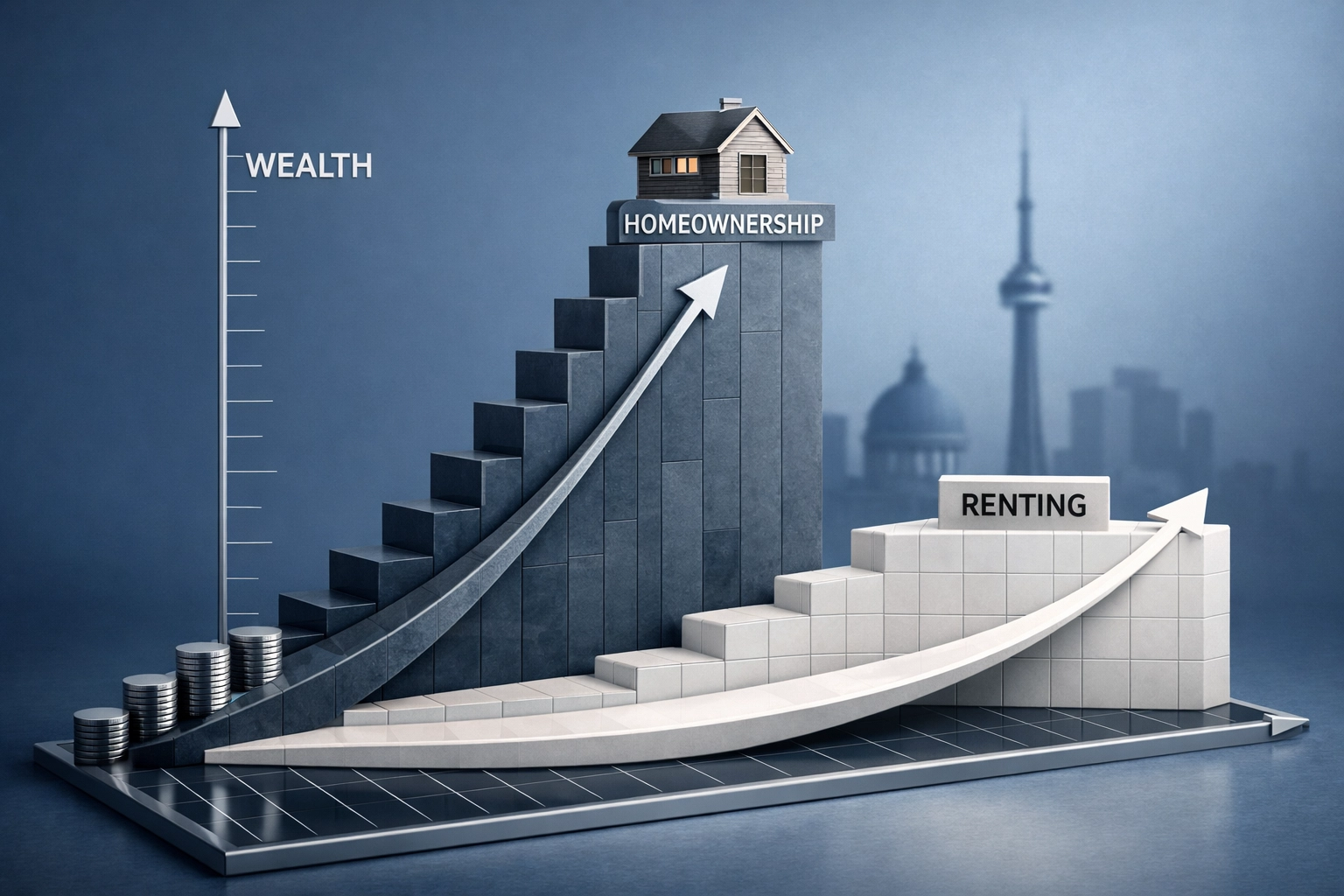
The Wealth Accumulation Divergence: 10-Year Projection
This is where the mathematical truth becomes undeniable.
Homeowner at Year 10:
- Principal paid: $139,000
- Property value (3% annual growth): $1,007,950
- Total equity: $357,950 (minus original $50,000 down = $307,950 net gain)
Renter at Year 10:
- Total savings invested: $67,428 × 1.05^10 (growing annually) ≈ $191,000
The homeowner’s net worth advantage: $116,950.
This differential exists even with conservative appreciation assumptions. In markets experiencing 4%–5% annual growth: as many Ontario regions saw during the 2000–2022 cycle: the gap widens to $200,000+.

When Renting Is the Mathematically Superior Choice
Financial transparency requires acknowledging scenarios where renting outperforms ownership:
Short-Term Residency (Under 3 Years): The upfront transaction costs: Land Transfer Tax, legal fees, CMHC premiums: cannot be amortized over a brief ownership period. If you’re relocating for a temporary contract or uncertain about your long-term plans, renting preserves capital flexibility.
High-Interest Rate Environments with Expected Declines: If current mortgage rates are historically elevated and you anticipate significant drops within 18–24 months, delaying purchase may be strategic. However, attempting to “time” the market is notoriously unreliable.
Liquidity-Constrained Situations: If deploying your entire capital reserve into a down payment leaves you vulnerable to emergency expenses or prevents investment in higher-return opportunities (business ventures, professional development), maintaining renting flexibility may be prudent.
Market-Specific Overvaluation: Certain Ontario submarkets experience price-to-rent ratios that defy fundamental economics. When monthly ownership costs exceed comparable rent by 75%+, proceed with caution and conduct rigorous due diligence.
The Fiduciary Perspective: What TRESA Standards Demand
Under The Trust in Real Estate Services Act (TRESA), real estate professionals owe clients a duty of honest, good faith conduct. This means providing transparent analysis: not pushing homeownership universally.
At BuyRealty.ca Brokerage, our approach involves comprehensive financial modeling specific to each client’s situation. We examine:
- Actual after-tax cost of borrowing
- Municipal-specific property tax burdens
- Neighborhood appreciation trends (using TRREB, RAHB, or regional board data)
- Alternative investment returns on saved capital
This isn’t about closing transactions: it’s about advising clients toward mathematically sound decisions aligned with their long-term wealth strategy.
The Hidden Variables: Maintenance, Mobility, and Risk
Two critical factors often escape initial analysis:
Maintenance Volatility: The 1% annual maintenance rule is an average. In any given year, you might spend $0 or $15,000 replacing a roof. Homeownership requires capital reserves for unexpected repairs: a reality renters avoid entirely.
Career Mobility: Ontario’s employment market increasingly rewards geographic flexibility. If your industry demands relocation every 2–3 years, the transactional friction of buying and selling erodes wealth rather than building it.
The 2026 Ontario Context: Current Market Realities
As of February 2026, Ontario’s real estate landscape reflects several key trends:
- Interest rates remain elevated relative to the 2015–2021 period, increasing borrowing costs
- Inventory levels have normalized in many Greater Toronto Area neighborhoods, reducing bidding war frequency
- Provincial housing policy continues emphasizing supply expansion, particularly through Greenbelt consultations and municipal intensification mandates
- Rent control exemptions for post-November 2018 builds create greater rental cost uncertainty for newer units
These conditions create a more balanced negotiating environment for buyers while simultaneously introducing rental cost volatility for certain tenant segments.
The Verdict: Mathematics Favors Ownership at 5+ Year Horizons
For Ontario residents planning to remain in a region for five years or longer, homeownership delivers superior wealth accumulation under virtually all reasonable appreciation scenarios.
The mathematical advantage stems from:
- Forced savings through mortgage principal reduction
- Leveraged appreciation on the full property value, not just your down payment
- Inflation protection as housing typically tracks or exceeds inflation over extended periods
- Rent avoidance in retirement, reducing required income during fixed-income years
However, this conclusion requires meeting baseline conditions: stable employment, adequate emergency reserves, and realistic assessment of carrying costs.
Next Steps: Getting Your Personalized Analysis
Generic calculations provide frameworks: but your decision requires Ontario-specific, situation-specific modeling.
Cathy Dou and the team at BuyRealty.ca Brokerage offer comprehensive rent-versus-buy consultations at no cost and no obligation. We’ll analyze:
- Your current savings and borrowing capacity
- Target neighborhoods and realistic acquisition costs
- Break-even timelines based on actual market data
- Alternative scenarios if your timeline or location shifts
Real estate in Ontario isn’t just about the transaction; it’s about navigating a complex financial decision with absolute clarity. In a shifting market, transparent mathematical analysis is the greatest asset we can offer.
Contact us today to move beyond generic advice and into actionable, personalized strategy.